The Use and Importance of Gearboxes in Industrial Kitchens
Industrial kitchens are professional production areas that operate at high capacity for restaurants, hotels, cafeterias, catering companies, meat processing facilities and food production plants. In these areas, the machines used must be powerful, durable, quiet and efficient. At this point, gearboxes stand out as one of the most important power transmission components that directly affect the performance of industrial kitchen equipment.
A gearbox reduces the high-speed rotation coming from the electric motor and provides a more controlled and powerful torque output. In industrial kitchen machines, this feature helps equipment operate more smoothly and efficiently in many processes such as meat grinding, dough kneading, mixing, chopping, conveying and packaging.
Why Are Gearboxes Used in Industrial Kitchens?
Industrial kitchen equipment is exposed to long and intensive working hours throughout the day. In order for these machines to use motor power correctly, gearbox systems are required. Gearboxes reduce motor speed to the proper level while increasing the torque needed by the machine. As a result, equipment operates more powerfully and mechanical stress is reduced.
Gearboxes provide significant advantages in terms of production quality and machine life, especially in equipment such as meat grinders, dough kneading machines, mixers, vegetable chopping machines and conveyor systems.
Gearbox Use in Meat Grinders
One of the most common areas where gearboxes are used in industrial kitchens is meat grinding machines. During the meat grinding process, the machine requires high torque, balanced rotation speed and continuous working performance. The gearbox transfers motor power to the grinding mechanism in a controlled way, helping the meat to be processed more uniformly.
A high-quality meat grinder gearbox helps the machine operate without excessive strain. This supports energy efficiency and also helps components such as the motor, blade and auger last longer.
The Role of Gearboxes in Dough Kneading and Mixing Machines
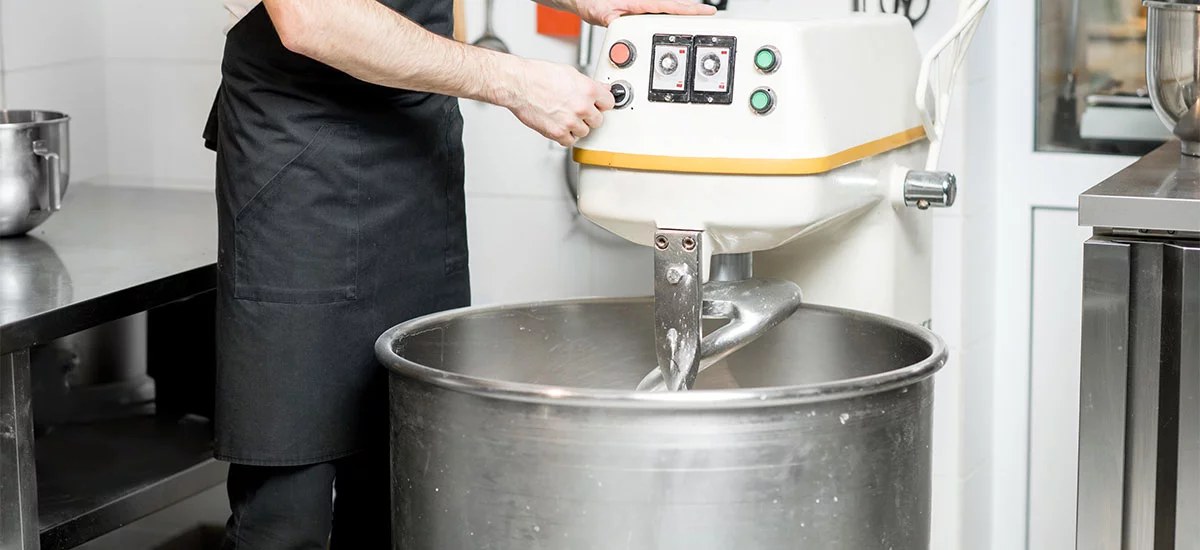
Dough kneading machines used in bakeries, pastry shops, hotel kitchens and food production facilities are machines that work under high resistance. Due to the dense structure of dough, the machine must produce strong and stable torque. Gearboxes reduce motor speed and allow the kneading bowl or mixing arm to rotate with the required power.
Gearbox use is also highly important in mixing machines. Proper speed and strong torque are required to mix sauces, soups, creams, tomato paste, fillings and similar food products evenly. A correctly selected gearbox improves product quality while helping the machine operate more quietly and steadily.
Gearboxes in Vegetable Chopping and Food Processing Machines
Industrial vegetable chopping machines, fruit processing machines and various food preparation equipment also benefit from gearbox-driven systems. In these machines, blades, drums or rotating mechanisms must operate at a controlled speed. Excessively high speed may cause the product to be crushed or cut in an undesired way.
Thanks to the gearbox, the machine operates with the proper balance of speed and power for the product being processed. This helps preserve cutting quality and ensures standard results throughout the production process.
Gearbox Use in Conveyor and Transport Systems
In industrial kitchens and food production facilities, conveyor systems are used to move products from one point to another. In these systems, belt speed must be controlled. Gearboxes reduce the movement coming from conveyor motors to the appropriate speed, ensuring that products are transported safely and regularly.
Gearbox-driven conveyor systems save time, labor and energy for businesses, especially in packaging, sorting, washing, cooling and production line applications.
What Should Be Considered When Choosing an Industrial Kitchen Gearbox?
When choosing a gearbox for industrial kitchen equipment, factors such as the machine’s operating method, motor power, required speed, torque value, mounting position and working duration should be considered. An incorrectly selected gearbox may cause the machine to operate inefficiently, overheat, make noise or fail prematurely.
For machines used in the food industry, hygiene, quiet operation, durability and ease of maintenance are also important criteria. Therefore, when selecting a gearbox for industrial kitchen machines, not only the price but also product quality and technical compatibility should be evaluated.
Advantages of Using a High-Quality Gearbox
A high-quality gearbox provides high performance and long service life in industrial kitchen machines. Proper transmission of motor power contributes to balanced energy consumption and more efficient equipment operation. In addition, reduced vibration and noise levels help create a more comfortable working environment.
The gearbox’s durable housing structure, suitable gear system and high-efficiency power transmission capability are highly important for production continuity in industrial kitchens.
Reliable Solutions for Industrial Kitchens with Öztekfen Gearbox
Choosing the right gearbox is critical for ensuring that machines used in industrial kitchens operate smoothly for a long time. Öztekfen Gearbox offers reliable alternatives in industrial power transmission with gearbox solutions developed for different sectors.
Suitable gearbox solutions for meat grinders, mixers, chopping equipment, conveyor systems and various food processing machines help businesses increase production capacity while reducing maintenance and breakdown costs.
Conclusion
The use of gearboxes in industrial kitchens is not only about reducing motor speed. Gearboxes play a critical role in power transmission, torque control, energy efficiency, machine life and production quality. A correctly selected gearbox allows industrial kitchen equipment to operate more safely, powerfully and efficiently.
For businesses aiming for high performance and long-lasting use in professional kitchen equipment, choosing a high-quality gearbox is an essential part of the production process.